THE SHAKESPEARE BRIDGE AT 100
Robert Metcalf, Reinforced Concrete, and the Building of Franklin Hills, 1924–1926
In 2026, Franklin Hills marks a hundred years since its modern shape first took form: the Shakespeare Bridge spanning the old Arroyo de Sacatela ravine, and the network of streets that turned a steep, undeveloped hillside into a neighborhood. The contractor's name attached to that work in the city's own records is Robert Metcalf. This summary gathers what primary sources — city monument files, federal engineering records, and period photographs — actually document about that 1926 construction effort: how the bridge was built, what is and isn't known about Metcalf himself, and how concrete streets were generally built in Los Angeles at the time.
It also flags, openly, where the documentary trail runs out — so that neighbors with family records, old photographs, or memories can help fill the gaps.
The Shakespeare Bridge
Origins and Design
Officially the Franklin Avenue Bridge, the span everyone calls the Shakespeare Bridge was designed by J.C. Wright, a civil engineer with the Los Angeles Bureau of Engineering, to connect Franklin Avenue across a roughly 35-foot-deep ravine to the Ivanhoe Tract (also called Franklin Hills). The project was financed through a special assessment district rather than the city treasury — meaning nearby property owners paid for it directly. That financing structure was contested almost immediately: the Los Feliz Improvement Association protested the assessment as early as 1924, arguing the bridge chiefly benefited landowners on one side of the ravine.
Construction Timeline and Cost
Work began in 1924 and finished in October 1926, per a 1973 phone interview with Metcalf's daughter, Catherine Metcalf McGowan, preserved in the Historic-Cultural Monument file. The finished bridge cost $59,960. Robert Metcalf is named in the city's records as the general contractor; J.C. Wright's office handled the engineering design.
How It Was Built: 1926 Reinforced Concrete Technique
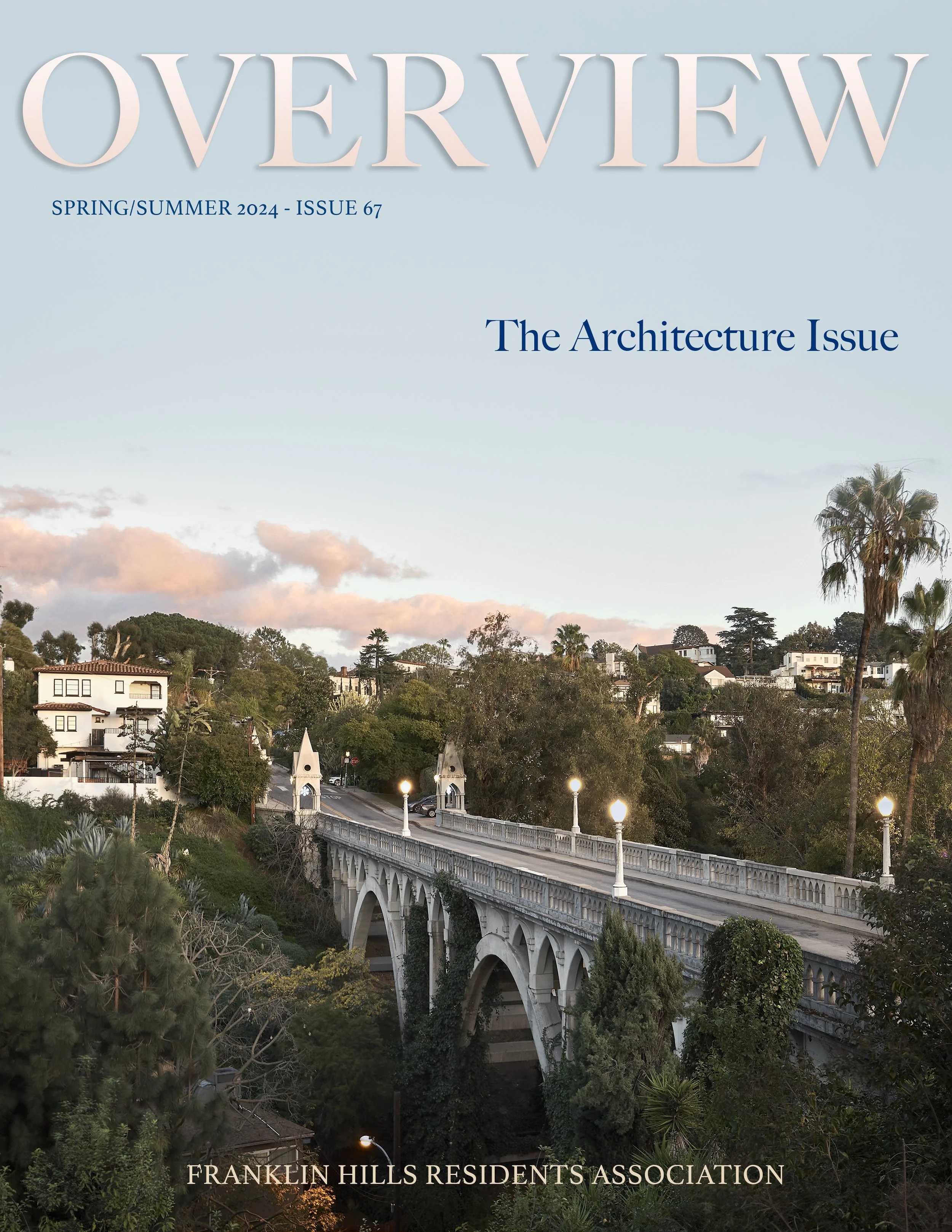
The bridge is 262 feet long and 30 feet wide, built of reinforced concrete with spread footings, concrete abutments, and three unequal-length open-spandrel arches, carrying a two-lane Portland cement deck and one sidewalk.
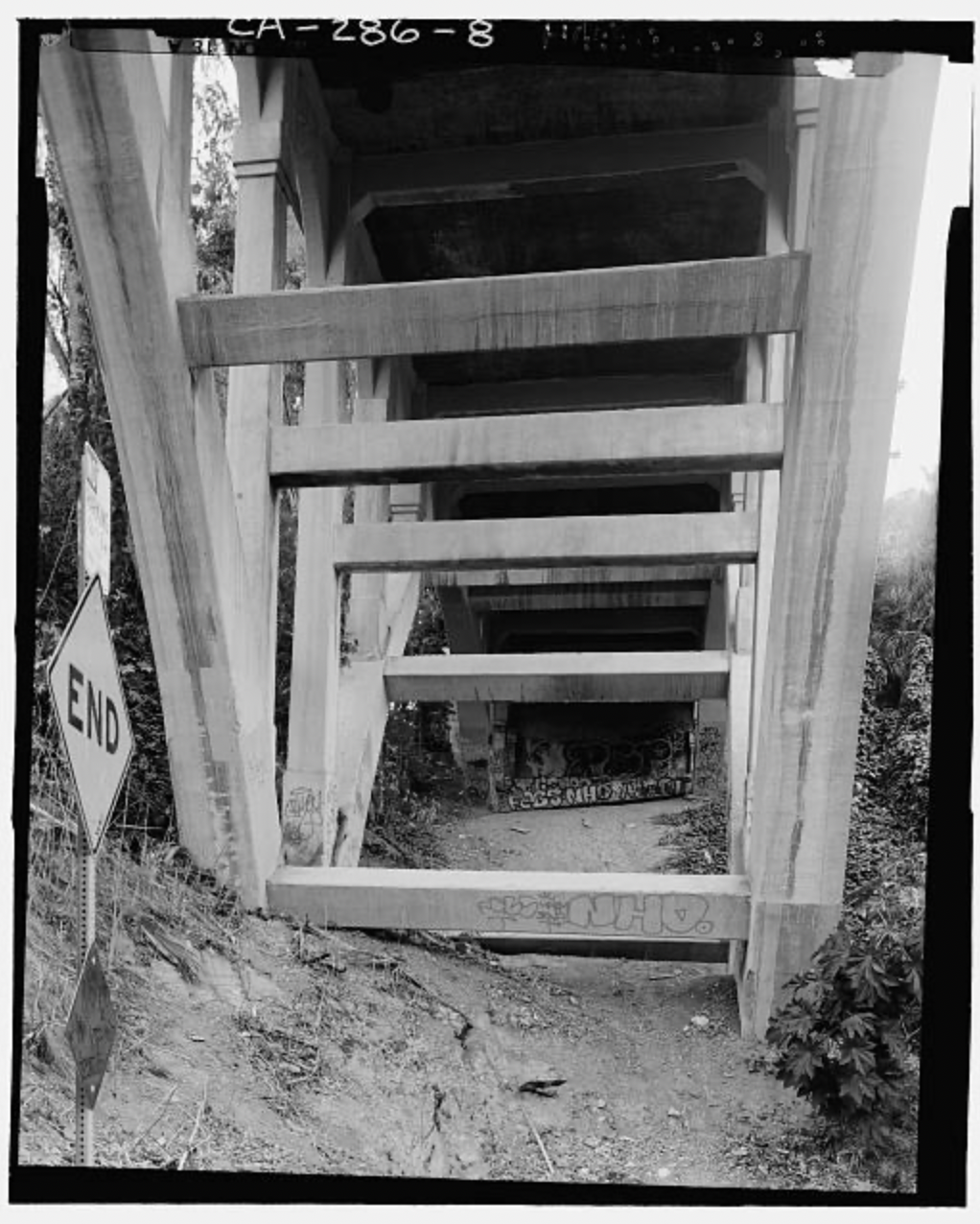
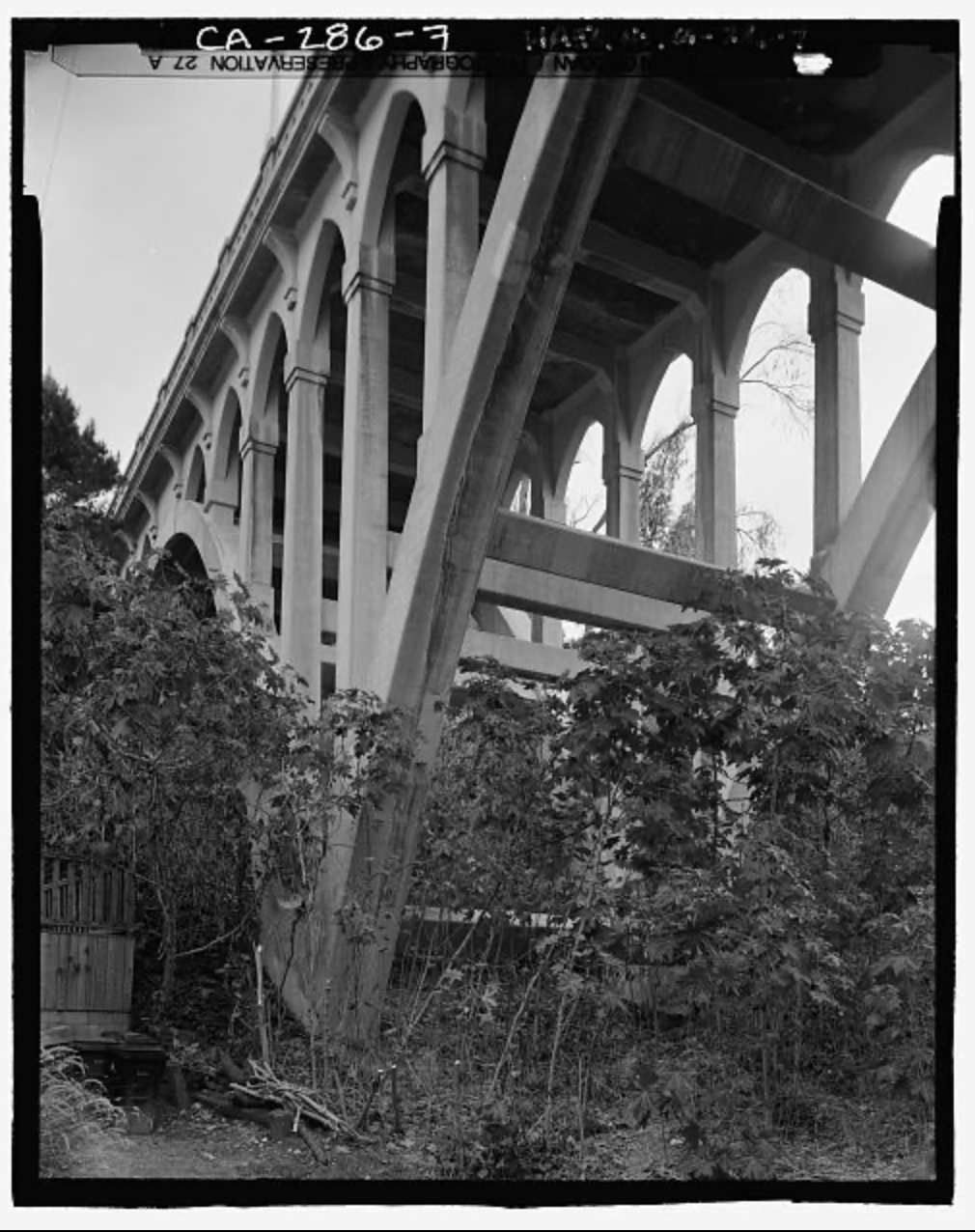
The open-spandrel arch was the prestige bridge form of the 1910s and 1920s. Older “closed-spandrel” bridges filled the space between arch and deck with earth, retained by solid concrete walls — simple, but heavy. Open-spandrel construction instead carries the deck on a row of slender concrete columns rising directly off the arch ring, cutting dead weight substantially at the cost of far more complicated formwork. That tradeoff was exactly the point on a residential street bridge built to look monumental without the engineering budget of the city's big Los Angeles River crossings of the same decade.
In practice, a job like this followed a fairly fixed sequence. Surveyors staked the arch geometry against Wright's drawings. Carpenters then built timber falsework — temporary centering — down into the ravine to support curved wooden form panels until the concrete gained enough strength to stand on its own. Reinforcing steel went into the forms before each pour, since the open-spandrel design depends on steel, not mass, to carry tension through the arch and columns. Concrete was mixed at or near the site — ready-mix delivery trucks did not yet exist in the 1920s — and placed in lifts: footings and abutments first, then the arch rings, then the spandrel columns, and finally the deck slab and the sidewalk. Only after the deck cured and the falsework was struck (removed) did the Gothic turret ornament go up at each end.
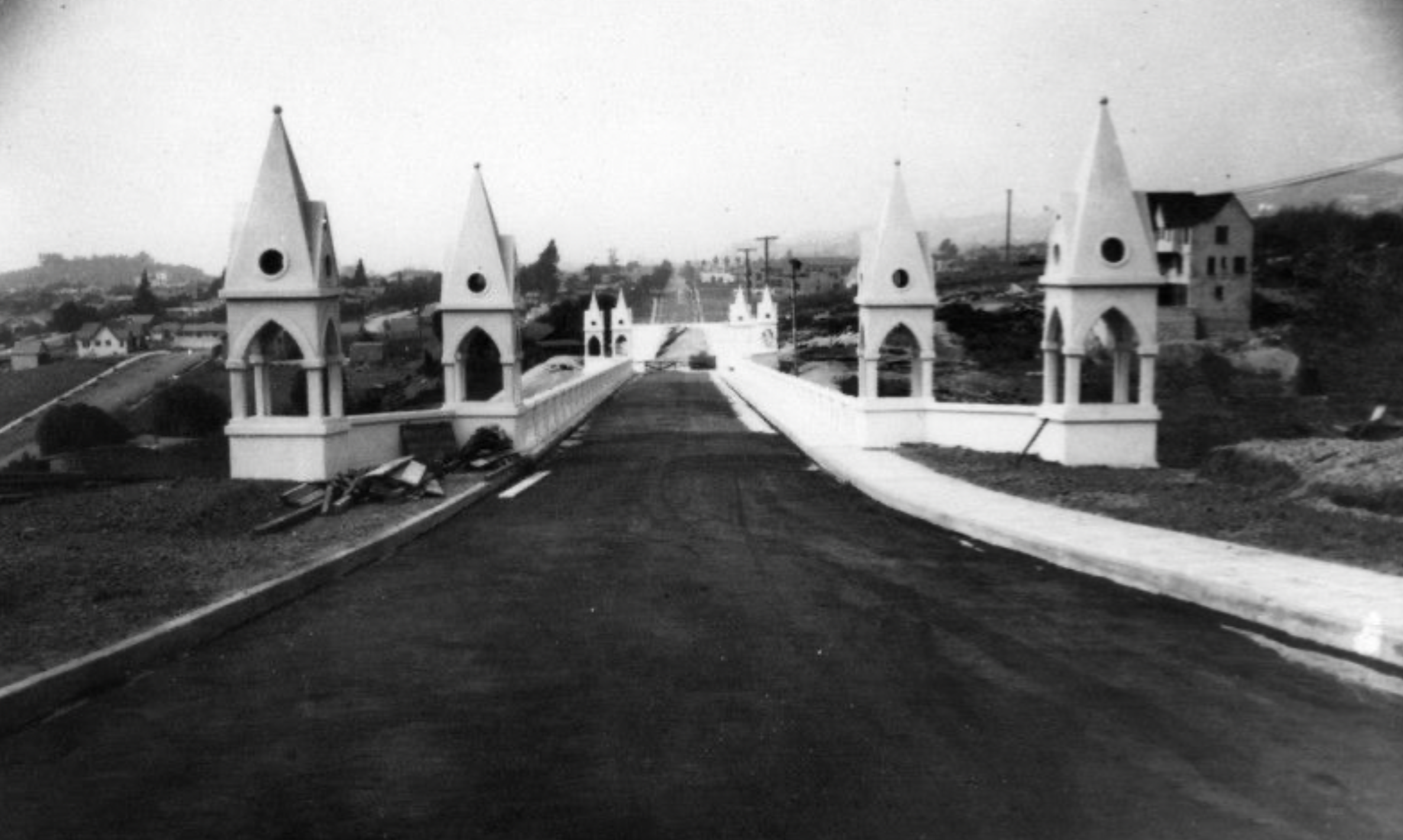
Those turrets very nearly didn't happen. The Municipal Art Commission required the decorative towers as a condition of approving the design — and when the bridge was finished, an unnamed Los Angeles Times writer of the day still called the new cupolas “atrocious,” describing them as sticking out awkwardly. A century later, those same turrets are the bridge's most photographed feature.
From Eyesore to Landmark
The bridge was designated Los Angeles Historic-Cultural Monument No. 126 in 1974. It was substantially retrofitted after the 1994 Northridge earthquake, when a 1986 Bureau of Engineering seismic analysis had already flagged the structure as inadequate for transverse loading and recommended repair of the railings, turrets, arches, and struts.
Robert Metcalf, the Contractor
The documentary record on Metcalf the person is thin — a reminder of how little public paper trail general contractors on municipal jobs left in the 1920s unless something went wrong.
What the record shows
• Named as general contractor on the bridge in the city's own Historic-Cultural Monument file and in the Library of Congress's Historic American Engineering Record (HAER No. CA-286).
• Built the bridge over roughly two years, 1924 to October 1926, per his daughter Catherine Metcalf McGowan's 1973 account to the Los Feliz Improvement Association.
• Family ties to the neighborhood: as of that 1973 interview, McGowan was living at 4311 Kingswell Avenue — inside Franklin Hills itself.
What remains undocumented
• No contractor biography, obituary, company record, or trade-press mention of Metcalf turned up in searchable archives, newspaper indexes, or city directories.
• The broader claim that Metcalf graded or paved most of the surrounding street network — beyond the bridge contract itself — could not be independently verified from publicly available sources. It may well be true; the best path to confirming it would be the Los Angeles County Recorder's tract maps for the Ivanhoe Tract or the Bureau of Engineering's original permit ledgers, neither of which is digitized. Family records or longtime-resident accounts could also help close this gap.
Building 1926's Concrete Streets
While the bridge was the marquee project, the residential streets of Franklin Hills were going in around the same time, using the standard concrete street-paving methods of mid-1920s Los Angeles.
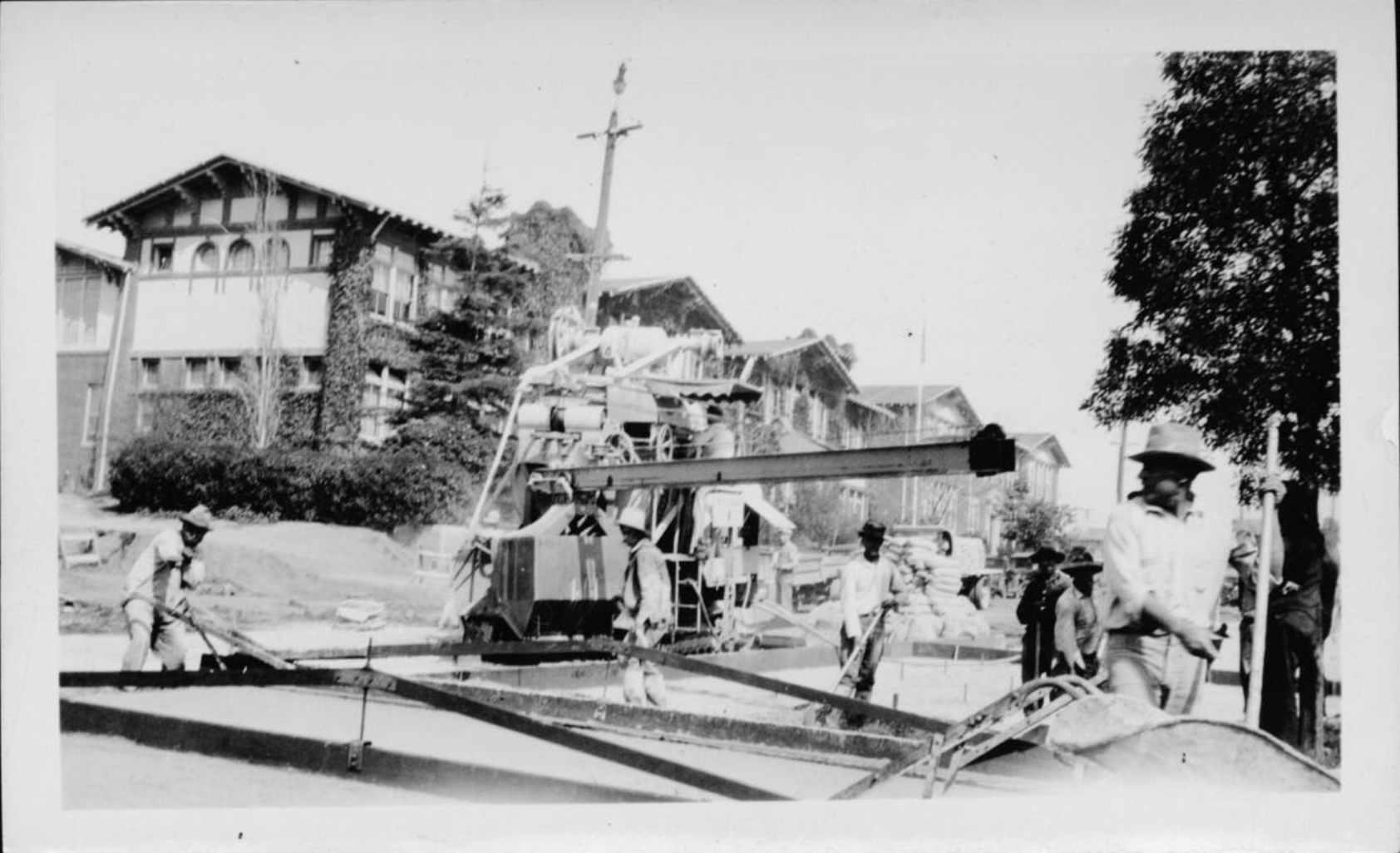
Ready-mix concrete trucks didn't exist yet in any practical form — the transit mixer wasn't commercialized until the 1930s. Through the 1920s, contractors mixed concrete on or near the job site, often running a small mobile batch plant and a narrow-gauge rail line to haul in sand, gravel, and cement. Crews graded the roadbed, set wooden side forms to the finished street width and grade, and placed the wet concrete inside those forms. A machine like the Rex 27-E paver — documented in period Los Angeles Department of Public Works photographs — would straddle the form rails and drag a finishing beam across the surface while a crew of several men worked behind it with hand floats, smoothing the slab by hand. Once the concrete had cured enough to handle traffic, joints between adjoining slabs were commonly sealed by hand with hot tar, poured from a spouted can and fed from a tar heater towed behind a truck.
It's the same Portland cement technology as the bridge deck, just at street scale: graded earth, wooden forms, steel only where needed, concrete placed and finished by hand, and time left for it to cure before the next block was opened to traffic.
Photographs
The images below are real, archived photographs documented during this research. I was not able to download the image files directly — the Library of Congress and USC/Calisphere archives both block automated downloads — so each entry below is a placeholder with the exact source link, a written description of what's in the photo, and a suggested credit line. Whoever finalizes this document for print or web should follow the link, save the image, and drop it into the placeholder box. (If it's easier, download the files and send them back to me — I can embed them directly into a revised version of this document.)
FIGURE 1 — PHOTO PLACEHOLDER
The Shakespeare Bridge, under construction, 1926
Wide view of the bridge during construction, from the Security Pacific National Bank Collection.
Source: Los Angeles Public Library, Security Pacific National Bank Collection
Link: View on Calisphere
Suggested credit line: Los Angeles Public Library Photo Collection, Security Pacific National Bank Collection
Usage: Check LAPL's Ordering & Use page before publishing; reproduction generally permitted with credit.
FIGURE 2 — PHOTO PLACEHOLDER
Franklin Avenue Bridge — HAER documentation photographs
A set of 10 historic photographs and a measured drawing, part of the federal Historic American Engineering Record (HAER No. CA-286).
Source: Library of Congress, Historic American Engineering Record
Link: Browse HAER CA-286 photo set
Suggested credit line: Library of Congress, Historic American Engineering Record, HAER No. CA-286
Usage: HAER photographs are U.S. government records and are in the public domain.
FIGURE 3 — PHOTO PLACEHOLDER
Workers smoothing a freshly poured concrete street with hand floats
About six workers rake and float wet concrete inside a wooden box frame behind a Rex 27-E paving machine; two-story Tudor-style homes are visible behind them — the same architectural style found throughout Franklin Hills.
Source: California Historical Society Collection at USC, via Calisphere
Link: View on Calisphere
Suggested credit line: University of Southern California. Libraries and California Historical Society
Usage: Public domain, released under a CC BY Attribution license — free to use with the credit line above.
FIGURE 4 — PHOTO PLACEHOLDER
Sealing joints in a new concrete street with hot tar
Four workers seal the joints between poured concrete slabs, one pouring tar from a spouted can; a tar-heater truck waits nearby.
Source: California Historical Society Collection at USC, via Calisphere
Link: View on Calisphere
Suggested credit line: University of Southern California. Libraries and California Historical Society
Usage: Public domain, released under a CC BY Attribution license — free to use with the credit line above.
FIGURE 5 — PHOTO PLACEHOLDER
Steam roller paving a Los Angeles street
A steam roller compacts a road surface as a crew with shovels follows behind; utility poles and railroad tracks run alongside the road. (Asphalt rather than concrete — useful as a contrast image showing the era's other major paving method.)
Source: California Historical Society Collection at USC, via Calisphere
Link: View on Calisphere
Suggested credit line: University of Southern California. Libraries and California Historical Society
Usage: Check Calisphere item page for specific rights statement before publishing.
FIGURE 6 — PHOTO PLACEHOLDER
The Shakespeare Bridge today
A modern photograph showing the bridge's Gothic turrets and open-spandrel arches, for comparison against the construction-era images above.
Source: Multiple contemporary sources, e.g. Los Angeles Explorers Guild
Link: Los Angeles Explorers Guild article
Suggested credit line: Photographer per source page
Usage: Confirm rights with the specific photographer/source before publishing; many present-day shots are reader-submitted or copyrighted.
1998 Shakespeare Bridge Re-Opening and Celebration & Median Dedication (created/directed/narrated by Bruce Carroll)